

Flocculation is the step in water treatment where fine particles stick together into larger clumps, called flocs, that are heavy enough to sink. Many public water systems use it before water reaches your tap. It is also why water treated at home in a jug, left standing, can show a layer on the bottom.
How does flocculation fit into water treatment?
Flocculation is gentle mixing that turns tiny particles into bigger, heavier ones. The CDC puts it in one line: "Flocculation is the gentle mixing of the water to form larger, heavier particles called flocs." It is one step in a sequence the CDC describes, and the CDC says different utilities use different treatment steps depending on the quality of their source water:
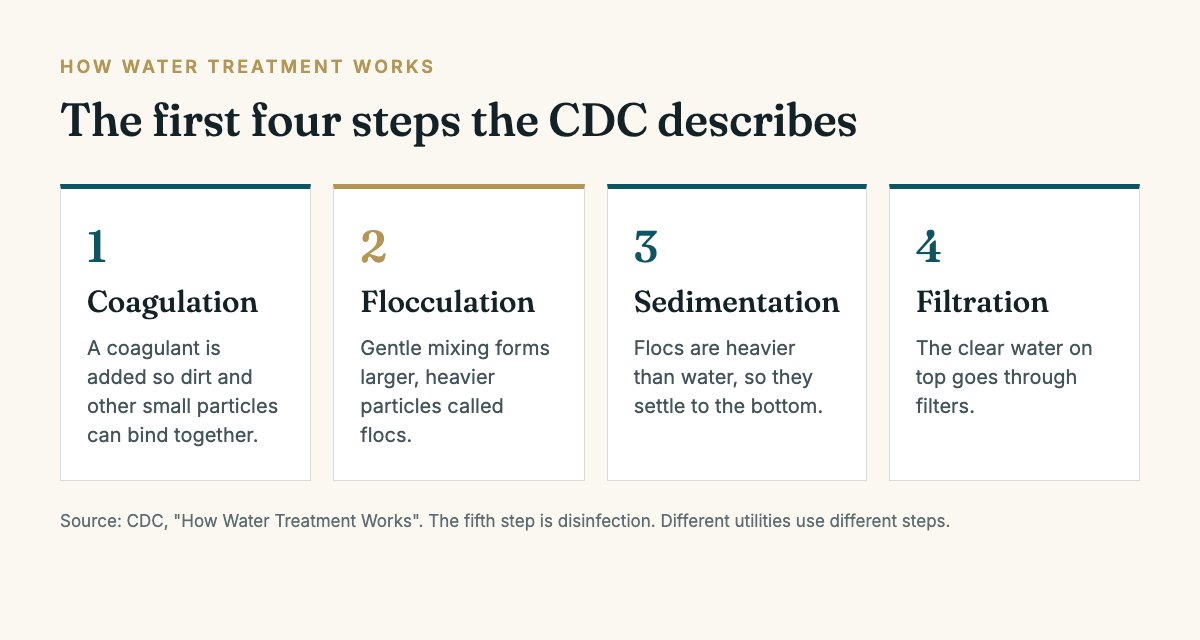
- Coagulation "Treatment plant staff add chemicals to the water that help bind together dirt and other small particles."
- Flocculation "the gentle mixing of the water to form larger, heavier particles called flocs."
- Sedimentation "Flocs are heavier than water, so they settle to the bottom of the water during this step."
- Filtration "Once the flocs have settled to the bottom of the water, the clear water on top goes through several filters."
What is the difference between coagulation and flocculation?
Coagulation starts the clumping; flocculation finishes it. Very fine particles tend to stay apart, so a coagulant is added to let them stick together; that clumping is what lets flocculation start. Flocculation is the slower mixing that follows, where small clusters keep meeting and growing until they are heavy enough to sink.
What is the layer at the bottom of a container of treated water?
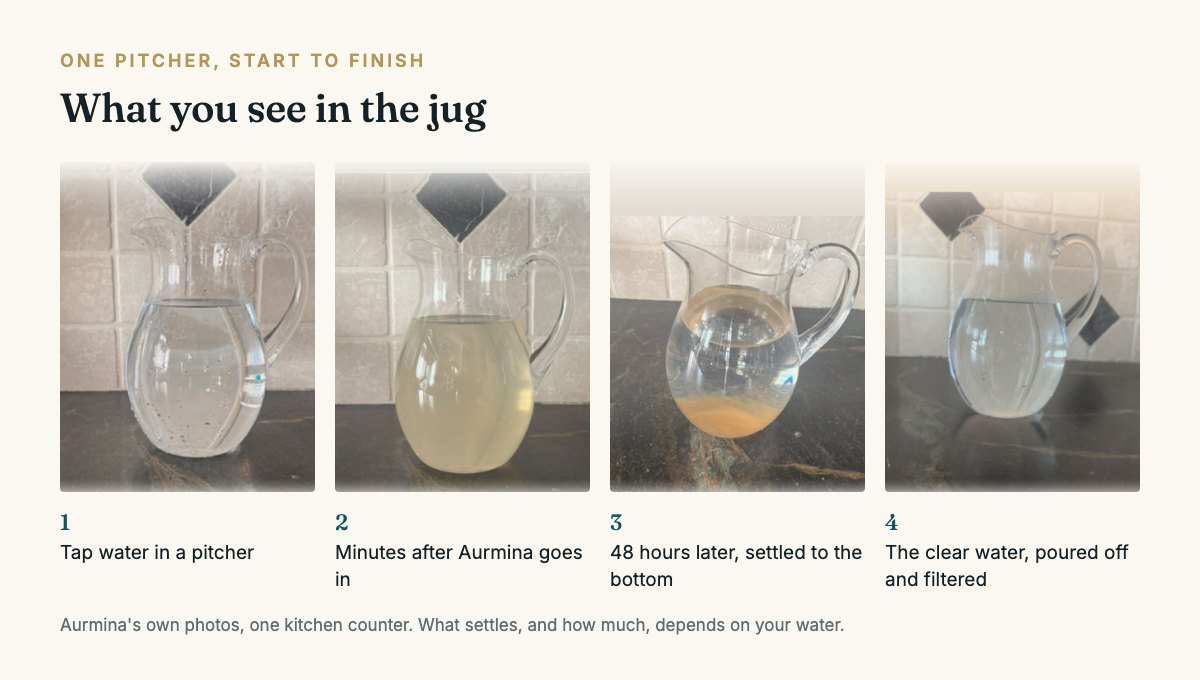
Whatever has clumped and settled collects at the bottom, because gravity does the last step. How much settles, and how it looks, varies with the water, so two kitchens may see a different layer. Aurmina brings major and trace minerals, in the ratios found in volcanic stone, for your water jug. Our FAQ gives one instruction about that layer: "don't drink the sediment. Pour the clear water off the top, or run it through a coffee filter, cheesecloth or a gravity filter."
How long does it take, and why might I see little or no sediment?
It depends on the water. Our product page gives the wait for tap water, and our FAQ notes: "warmer water settles faster; cold water slows everything down." How much settles depends on what is in your water to begin with.
Common questions
Is flocculation the same as filtration?
No. Flocculation clumps fine particles so they settle; filtration is the step after, when the water passes through a filter.
Does every water system use flocculation?
No. The CDC says different utilities use different treatment steps.
How long does flocculation take in a pitcher?
It depends on your water. Our product page gives the wait for tap water, and our FAQ notes that warmer water settles faster and cold water slows everything down.
Why does my Aurmina bottle have particles in it?
Our FAQ calls them "natural mineral precipitates" that can form with changes in temperature during storage and shipping, and says you can strain the solution through a coffee filter, cheesecloth or fine strainer.
Where to find Aurmina
See AurminaSources:CDC, How Water Treatment Works. Our FAQ, aurmina.com/pages/faqs.
Marketing support by PELORA Marketing