

0
Invisible
Municipal tap water. Nothing in it announces itself.
How to use
Turn any water — tap, purified, or spring — into clean, redox-balanced drinking water. About two minutes of hands-on time, tailored to your water.
The dose and the wait change with what you start from. Pick yours.
Your steps for tap or well water
Add 1–2 teaspoons of Aurmina per gallon — the higher end for heavier contaminant loads (some highly burdened sources need 3–4).
Wait 24–72 hours; the heavier the burden, the longer it takes to fully bind and settle.
Pour the clear water off the settled floc through a coffee filter or ceramic gravity filter, then drink.
Municipal tap water. Nothing in it announces itself.

Aurmina goes in. What was dissolved comes out of solution.

The burden is on the floor of the pitcher, no longer in the water.

Decanted off the sediment and through the filter. Same pitcher, same counter.
Detail · 48 hours
The floor of the same pitcher, photographed through the glass. Everything in this layer was dissolved in the water two days earlier.
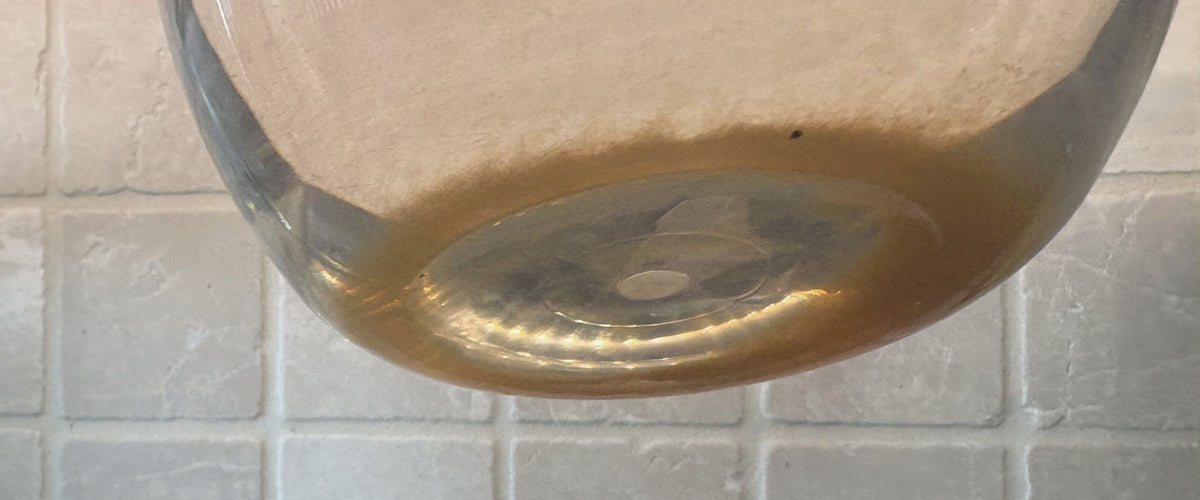
Photographed in a domestic kitchen, not a laboratory. Colour, volume and settling time vary with the source water. Measured reductions are reported separately.
In practice
Once you are treating more than a jug at a time, it helps to run a line of containers rather than one at a time — each treated a day apart, so there is always some finished and ready.
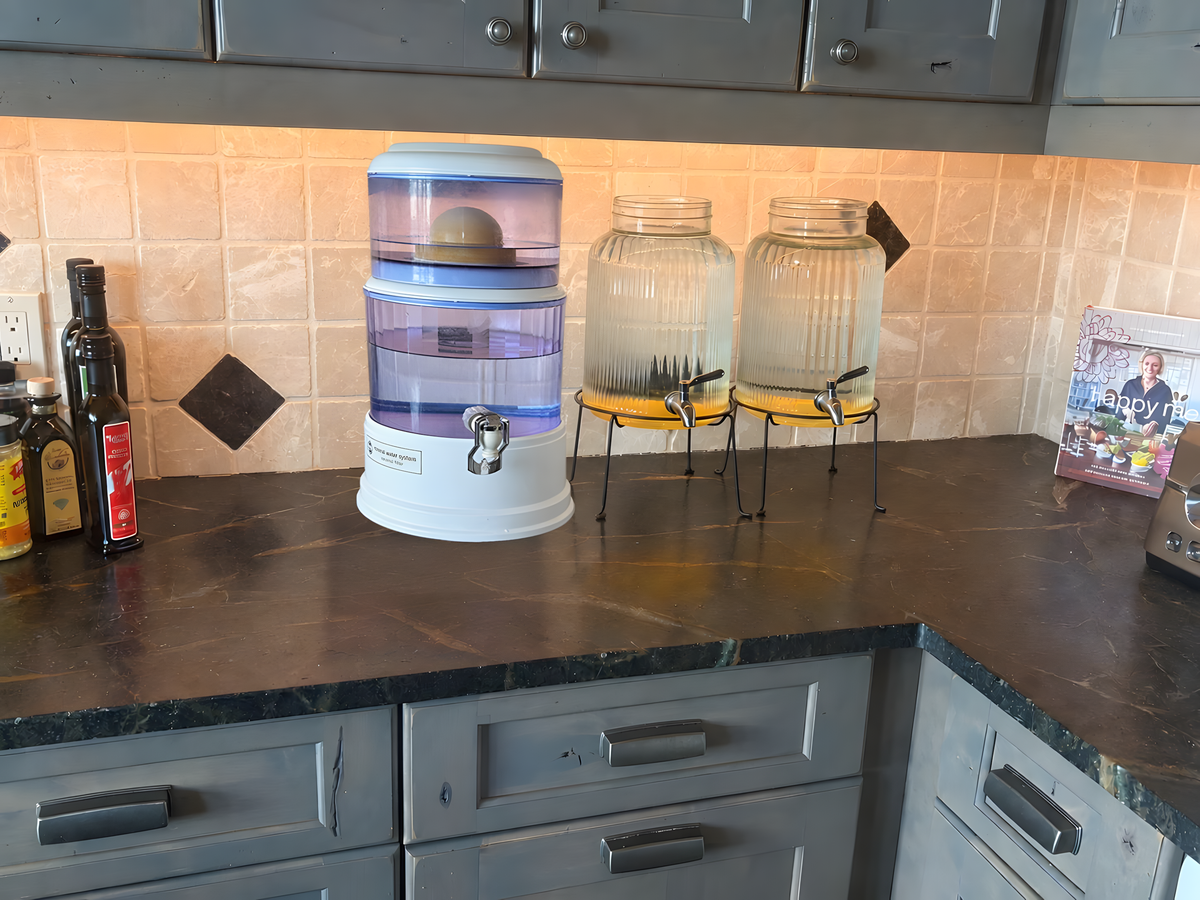
The mechanics are simple. Line up each filled container left to right — the longest-treated on the left, the most recently treated on the right. A ceramic gravity filter does the final polishing.
Whenever the level runs low, take the leftmost container in the line and pour it into the top of the gravity filter, leaving the bulk of the sediment behind in the container so it does not clog the filter. Then rinse, refill, and treat that emptied container, and set it at the end of the line on the right.
As the water passes into the filter’s lower chamber, it removes any fine particulates carried over, and you draw all your drinking and cooking water from the bottom spigot — clear, mineralized, and redox-balanced, at least closer to what water looked like before the Industrial Revolution. When the flow slows as the pores clog, the top chamber lifts off and rinses clean under warm water.
In practice it becomes a small morning ritual: start the coffee, and while it brews, move the line along — pour, rinse, refill, treat, and set at the end. Gravity filtration comes last and does none of the main purifying; it removes only the small amount of fine material that carries over.
Then drink enough
Aim for about half to two-thirds of your body weight in ounces of water a day. For a 150-lb person, that is roughly 75–105 oz (2.2–3.1 L) of Aurmina water.
Drink more for heat, exercise, or altitude. If a clinician has advised you to limit your fluids, follow their guidance. This is general hydration guidance, not medical advice.
These statements have not been evaluated by the Food and Drug Administration. This product is not intended to diagnose, treat, cure, or prevent any disease.
Kick it up a notch
The method above works for almost everyone. But if you like to get into your water, you can match the dose exactly to what your tap is carrying — dialing it to the point where more minerals pull out no more sediment, the way we do at home.
These statements have not been evaluated by the Food and Drug Administration. This product is not intended to diagnose, treat, cure, or prevent any disease.
One bottle goes a long way — from about 96 gallons of heavily burdened tap water to nearly 380 gallons of reverse-osmosis water.